
Four methods exist for calculating lean body mass, from a one-line equation you can solve on paper to a lab-grade DEXA scan. Each trades accuracy for convenience. Below are the actual coefficients and worked examples for men and women, so you can pick the method that fits what you have available.
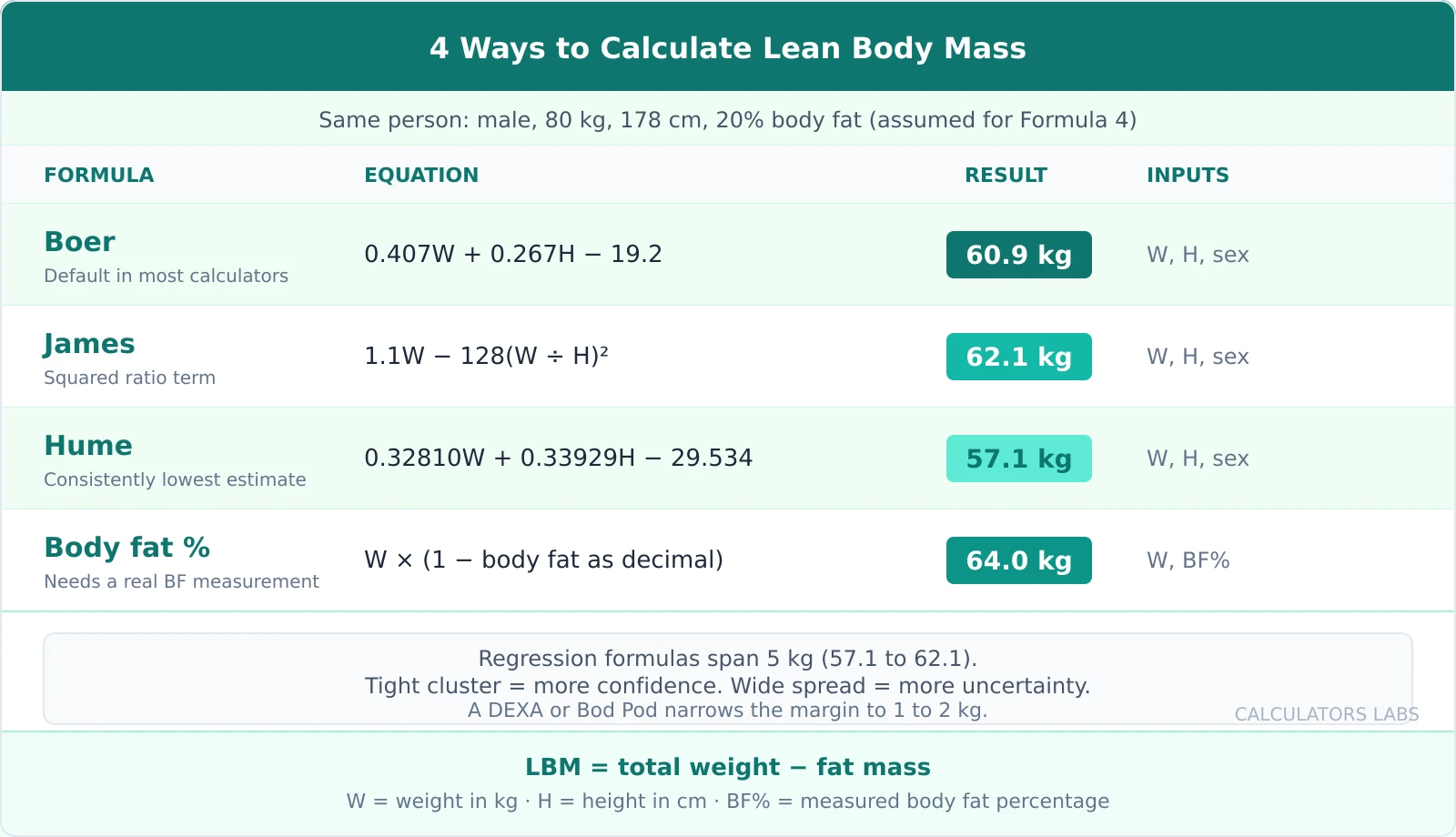
Table of Contents
- What LBM actually measures
- Formula 1: Boer equation
- Formula 2: James equation
- Formula 3: Hume equation
- Formula 4: body fat percentage method
- Side-by-side comparison
- Which formula should you use?
- Worked examples
- What to do with your LBM number
- Frequently asked questions
- References
What LBM actually measures
Lean body mass is total weight minus fat mass. It includes muscle, bone, organs, water and connective tissue. It is not the same as muscle mass, because bone density and hydration shift the number independently of how much muscle you carry. Two people at the same weight can have very different lean masses depending on body fat, and that difference changes protein targets, calorie needs and training approach.
Research sometimes distinguishes "fat-free mass" (zero fat) from LBM (which includes a small amount of essential fat), but in practice most calculators and fitness plans treat them as interchangeable. The Lean Body Mass Calculator runs three of the four formulas below in one step.
Formula 1: Boer equation
Published by P. Boer in 1984, this is the default in most online calculators because it uses only weight (W in kg) and height (H in cm) alongside sex:
Women: LBM = 0.252 × W + 0.473 × H − 48.3
For an 80 kg, 178 cm man: 0.407 × 80 + 0.267 × 178 − 19.2 = 60.9 kg lean mass. The equation is a linear regression, so it cannot account for unusually muscular or unusually heavy individuals. It tends to underestimate lean mass at very high body fat levels.
Formula 2: James equation
The James equation adds a squared term that makes it slightly more sensitive to the ratio between weight and height:
Women: LBM = 1.07 × W − 148 × (W / H)²
Same 80 kg, 178 cm man: 1.1 × 80 − 128 × (80 / 178)² = 62.1 kg. The squared ratio penalises heavy-for-height people more aggressively than Boer does, which is why James sometimes returns a lower number for overweight individuals and a higher number for lean ones.
Formula 3: Hume equation
Hume uses a different set of linear coefficients with five-decimal precision:
Women: LBM = 0.29569 × W + 0.41813 × H − 43.2933
At 80 kg and 178 cm: 0.32810 × 80 + 0.33929 × 178 − 29.5336 = 57.1 kg. Hume consistently returns the lowest of the three for men and often the lowest for women too. When all three formulas cluster within a kilogram or two, you can be more confident in the estimate; a wide spread signals more uncertainty.
Formula 4: body fat percentage method
If you already have a body fat measurement (from DEXA, a Bod Pod, hydrostatic weighing or even calipers), skip the regression equations entirely:
A 185 lb man at 20% body fat: 185 × (1 − 0.20) = 148 lb lean. A 140 lb woman at 25%: 140 × (1 − 0.25) = 105 lb. This is the only method that uses measured body composition rather than a population-average regression, so it is the most accurate when the input measurement is reliable. The catch is that the measurement itself carries error: calipers can be off by 3 to 4 percentage points depending on the tester, and even DEXA has a margin of about 1 to 2 points.
Side-by-side comparison
All four formulas applied to the same 80 kg, 178 cm man (body fat assumed at 20% for Formula 4):
| Formula | Inputs needed | Result | Best for |
|---|---|---|---|
| Boer | Weight, height, sex | 60.9 kg | General use, most calculators |
| James | Weight, height, sex | 62.1 kg | Leaner individuals |
| Hume | Weight, height, sex | 57.1 kg | Conservative estimate |
| Body fat % | Weight, measured BF% | 64.0 kg | When a real BF reading exists |
The three regression formulas span 5 kg here. That range reflects their different derivation populations, not an error in any single equation. A DEXA or Bod Pod measurement narrows the uncertainty to 1 to 2 kg.
Which formula should you use?
If you have a body fat reading from a scan or calipers, the body fat percentage method (Formula 4) is the most direct because it skips population averages entirely.
Without a measurement, the Boer equation is the standard default and is what the Lean Body Mass Calculator reports as its headline number. Running all three gives you a range, and the tighter that range, the more you can trust any single number in it.
None of these replaces an actual body composition scan for clinical or research purposes. They are screening estimates, good enough for setting initial protein and calorie targets but too coarse for tracking small changes over weeks.
Worked examples
Example 1: Man, 80 kg, 178 cm
- Boer: 0.407 × 80 + 0.267 × 178 − 19.2 = 60.9 kg lean (76.1% of body weight)
- James: 1.1 × 80 − 128 × (80 / 178)² = 62.1 kg
- Hume: 0.32810 × 80 + 0.33929 × 178 − 29.5336 = 57.1 kg
- Estimated fat mass (Boer): 80 − 60.9 = 19.1 kg
Example 2: Woman, 62 kg, 165 cm
- Boer: 0.252 × 62 + 0.473 × 165 − 48.3 = 45.4 kg lean (73.2%)
- James: 1.07 × 62 − 148 × (62 / 165)² = 45.4 kg
- Hume: 0.29569 × 62 + 0.41813 × 165 − 43.2933 = 44.0 kg
- Estimated fat mass (Boer): 62 − 45.4 = 16.6 kg
Boer and James agree closely for this woman, while Hume sits about 1.4 kg lower. The BMI Calculator gives a weight-based category from the same inputs, and the Asian BMI Calculator applies adjusted thresholds for people of South or East Asian descent.
What to do with your LBM number
Fat tissue burns little energy and needs little protein, so basing targets on lean mass rather than total weight avoids overshooting when body fat is elevated.
- Protein: 0.7 to 0.8 g per lb of LBM to maintain muscle, 0.8 to 1.0 to build, 1.0 to 1.2 while cutting. At 148 lb lean, 0.8 g/lb gives about 118 g of protein per day.
- BMR (Katch-McArdle): 370 + 21.6 × LBM in kg. At 62.1 kg lean, that is roughly 1,711 kcal per day. This variant needs no age or sex input because lean mass already captures those differences.
- TDEE: multiply BMR by an activity factor (1.2 sedentary through 1.9 for twice-daily training) to estimate total daily energy expenditure.
Hydration matters here because water is part of lean mass. A 2% swing in body water can shift LBM by over a kilogram, which ripples into your protein and calorie math. The Water Intake Calculator helps set a daily baseline, and how much water to drink in hot weather covers adjustments for heat. If you also track where fat sits, waist size and waist-to-height ratio catches belly-fat risk that lean mass cannot.
Frequently asked questions
What is the most accurate way to calculate lean body mass?
Using a measured body fat percentage from a DEXA scan, Bod Pod, or hydrostatic weighing, then applying the formula LBM = weight × (1 − body fat as a decimal). The measurement itself carries some error (1 to 4 percentage points depending on the method), but it is more individual-specific than any height-and-weight regression.
What is the difference between lean body mass and muscle mass?
Lean body mass includes everything that is not fat: muscle, bone, organs, water, and connective tissue. Muscle is usually the largest single component, but bone density and hydration shift the number independently. You can gain LBM without gaining muscle (for example, by rehydrating), and lose LBM without losing muscle (for example, by dehydrating).
Which LBM formula is best for overweight individuals?
Boer is the standard default and handles a wide range of body types reasonably well. James tends to penalise heavy-for-height people more because of its squared ratio term, which can underestimate lean mass at high body fat levels. If you have a body fat measurement, the body fat percentage method avoids the regression altogether and gives a more direct answer.
Why do the Boer, James, and Hume formulas give different results?
Each was derived from a different study population with different statistical methods and sample sizes. The coefficients are population averages, not universal constants. When the three results cluster tightly, the estimate is more trustworthy; a wide spread signals more uncertainty about the true number.
Should I base protein intake on lean body mass or total body weight?
LBM gives a better target when body fat is elevated, because fat tissue drives very little protein demand. At higher body fat levels, using total body weight overshoots by a meaningful margin. A common range is 0.7 to 1.0 g per lb of LBM for active individuals, going toward the high end during a calorie deficit. The Lean Body Mass Calculator works out the number you need for that calculation.
References
- Boer P. (1984), Estimated lean body mass as an index, PubMed: original Boer equation derivation.
- Body Composition Methods, NIH / PubMed Central: peer-reviewed overview of measurement techniques and accuracy.
- CDC NHANES body composition data: population reference data underlying lean mass norms.