
On This Page
- How to use this calculator
- How this calculator is verified
- Concrete volume calculation
- Concrete slab calculator
- Concrete calculator in cubic yards
- How many bags of concrete do I need
- Concrete cost calculator
- Concrete footing volume calculator
- Concrete driveway calculator
- Column, Sonotube, and pier volume
- Concrete weight by volume
- Quikrete vs Sakrete: bag size guide
- Worked examples
- Frequently asked questions
How to Use This Calculator
Choose a shape from the dropdown at the top of the calculator: slab, footing, column, driveway, or post hole. Enter the dimensions, and the results update instantly. The main result shows cubic yards (the unit contractors use when ordering ready-mix). The grid below shows cubic feet, cubic meters, and the number of bags needed for both 60 lb and 80 lb sizes.
Wastage toggle
The 10% wastage checkbox is on by default. Concrete spills, formwork has minor imperfections, and ordering short means a second trip. The 10% buffer is standard practice on any poured job. Turn it off only if you are estimating for a quote comparison rather than an actual order.
Cost estimate
Enter the price per 60 lb bag to get a material cost estimate. The calculator multiplies the number of 60 lb bags by the price you enter. It does not include delivery charges, ready-mix costs, or labor, so treat it as a materials-only floor for budgeting purposes.
Dimensions to use
Enter length and width in feet. Enter thickness, depth, and diameter in inches: the calculator converts to feet automatically. Use inside dimensions for any form or mold. Outside dimensions include wall thickness, which overstates the concrete volume you actually need to fill.
How This Calculator Is Verified
Slab, footing, column, driveway, and post-hole are five separate volume formulas, not one formula with different labels. A column and a post-hole are both cylindrical, for example, but this calculator still runs them as distinct calculations with their own inputs, so each shape only asks for the dimensions it actually needs rather than a generic length-times-width-times-height applied everywhere.
Concrete Volume Calculation
Calculating concrete volume means converting shape dimensions into a cubic measure so you can order the right amount of material. Every common concrete job falls into one of two formulas: rectangular (slabs, footings, walls, driveways) or cylindrical (columns, Sonotubes, piers, post holes). Both are straightforward once the units are consistent.
Concrete Volume Calculation Formula
For any rectangular pour, length times width times thickness gives the concrete volume. For cylindrical pours, the standard cylinder equation applies.
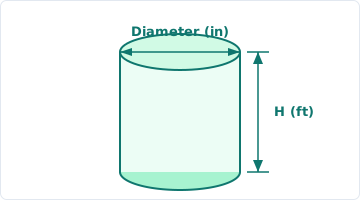
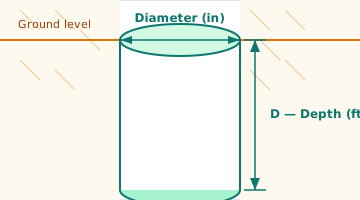
Cylindrical: V = π × (Diameter ÷ 24)² × Height
The diameter ÷ 24 step converts inches to feet and halves the result to get radius in one operation. Thickness for slabs is usually given in inches on site: divide by 12 to convert before multiplying. The result is cubic feet; divide by 27 to reach cubic yards.
How to Calculate Concrete Volume in Cubic Meters (m³)
To calculate concrete volume in m³, convert your final cubic feet result using the factor 0.0283168. One cubic meter equals 35.315 cubic feet, and one cubic yard equals 0.7646 cubic meters. Metric countries, as well as international specifications and ready-mix suppliers in the UK and Australia, quote volumes in m³.
m³ = cubic yards × 0.7646
This calculator displays cubic meters alongside cubic yards and cubic feet in every result, so no manual conversion is needed. A 10×10 slab at 4 inches = 33.33 cu ft = 1.23 cu yd = 0.94 m³.
Dry Volume vs Wet Volume of Concrete
Wet volume is the final mixed concrete volume you need to fill the formwork. Dry volume is the total volume of the dry ingredients (cement, sand, and coarse aggregate) required to produce that wet volume. Dry ingredients compact during mixing and the cement paste fills the voids between aggregate particles, so the dry volume is always larger than the wet volume.
The standard conversion factor is 1.54: multiply the wet volume by 1.54 to get the dry volume of materials needed.
- Wet volume needed: 10 cu ft (what the formwork holds)
- Dry volume of materials: 10 × 1.54 = 15.4 cu ft
This matters when you are mixing from raw materials rather than buying bagged concrete. For any job where you buy pre-mixed bags (Quikrete, Sakrete), the bag yield already accounts for this: the 0.45 cu ft per 60 lb bag is the wet (finished) volume, not the dry ingredient volume.
Concrete Mix Ratio by Volume
A concrete mix ratio by volume describes the proportion of cement: sand: coarse aggregate in the dry mix. The most common ratios for site-mixed concrete are:
- 1:2:4 (M15): standard residential slabs, sidewalks, and non-structural work; achieves roughly 2,200 PSI
- 1:1.5:3 (M20): general structural use, driveways, garage floors; achieves roughly 2,900 PSI
- 1:1:2 (M30): high-strength structural applications; achieves roughly 4,350 PSI
For 1 m³ of 1:2:4 concrete using the dry volume factor: dry volume = 1 × 1.54 = 1.54 m³. Total parts = 1+2+4 = 7. Cement = 1.54/7 = 0.22 m³ = approximately 6.3 bags of 50 kg (110 lb) cement. Sand = 0.44 m³. Aggregate = 0.88 m³. Pre-mixed bagged concrete removes all of this calculation from the job.
Concrete Wall Volume Calculator
A concrete wall uses the same rectangular formula as a slab. Treat the wall as length × height × thickness, all in feet.
Example: a retaining wall 20 feet long, 4 feet tall, and 8 inches thick. Thickness: 8 ÷ 12 = 0.667 ft. V = 20 × 4 × 0.667 = 53.3 cu ft = 1.97 cu yd. With 10% wastage: 2.17 cu yd. Walls often have footings at the base, so calculate the footing volume separately and add it. A wall footing is typically twice as wide as the wall and as deep as the wall is wide. For a simple rectangular block or cube-shaped form rather than a long wall, the Cube Volume Calculator gives the same length × width × height result with unit conversions built in.
Concrete Slab Calculator
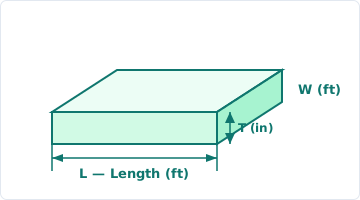
A concrete slab is a flat rectangular pour. The formula is straightforward: length times width gives you the area, and multiplying by the thickness gives you volume.

Thickness is almost always measured in inches on the job site, so divide by 12 to convert before multiplying. A 4-inch slab becomes 4/12 = 0.333 feet. The calculator handles this conversion for you.
Standard slab thicknesses
Thickness drives the volume more than most people expect. Doubling from 4 inches to 8 inches doubles the concrete needed, not the cost, which makes thickness selection a critical budget decision.
- 3.5 inches (minimum): sidewalks and light-traffic walkways only
- 4 inches: standard residential slab, patio, garage floor without heavy vehicles
- 5 to 6 inches: driveways, garage floors used by RVs or heavy equipment
- 6 to 8 inches: commercial floors, slabs supporting structural loads
Reinforcement and concrete slab materials
Most residential slabs use 6"×6" wire mesh or #3 rebar on 18-inch centers. Add 3 inches of compacted gravel base underneath to improve drainage and reduce cracking. Expansion joints cut every 8 to 10 feet prevent random cracking. None of this affects the concrete volume calculation, but it affects material cost.
For a 10×10 foot slab at 4 inches: V = 10 × 10 × 0.333 = 33.33 cu ft = 1.23 cubic yards. With 10% wastage, order 1.36 cubic yards, or 75 bags of 60 lb concrete.
Concrete Calculator in Cubic Yards
Cubic yards are the standard unit for ordering ready-mix concrete in the United States. The relationship between cubic feet and cubic yards is fixed: one cubic yard is a 3-foot cube, so it contains exactly 27 cubic feet.
This single conversion trips up more DIYers than any other step. Measuring a slab in feet gives you a result in cubic feet. Dividing by 27 converts to yards. Skipping that step produces orders that are 27 times too large, or a quote that is 27 times over budget.
How to calculate cubic yards of concrete
Three steps. First: find the volume in cubic feet (length × width × thickness in feet). Second: divide by 27. Third: add the wastage buffer.
Example for a 20×30 foot slab at 4 inches: V = 20 × 30 × 0.333 = 200 cu ft. Divide by 27 = 7.41 cu yd. Add 10%: 8.15 cubic yards. Order 8.5 yards to the nearest half-yard (most suppliers sell in half-yard increments).
Cubic yards to cubic meters
One cubic yard equals 0.7646 cubic meters. Multiply cubic yards by 0.7646 to convert. Or multiply cubic feet by 0.0283 directly. Metric countries order concrete in cubic meters, so this conversion matters for cross-border estimates or imported equipment specifications.
Ready-mix minimum orders
Most ready-mix suppliers have a minimum order of 1 cubic yard, and some charge short-load fees for orders under 3 or 4 cubic yards. For any project over about 1.5 cubic yards (roughly a 12×12 slab at 4 inches), ready-mix is usually faster and cheaper per cubic foot than bagged concrete once you factor in mixing labor.
How Many Bags of Concrete Do I Need
Bagged concrete comes in three main sizes, each yielding a fixed volume of mixed concrete. Divide the total cubic feet needed by the yield per bag, then round up to the nearest whole bag.
Always round up, never down. If the calculation gives 43.7 bags, buy 44. One short bag on a poured slab means either a thin spot or a second store run.
Bags per cubic yard: quick reference
For a full cubic yard (27 cubic feet), you need exactly 90 bags of 40 lb, 60 bags of 60 lb, or 45 bags of 80 lb. These are theoretical minimums. In practice, add 10% for spillage and overfill, making the real numbers closer to 99, 66, and 50 bags respectively.
When to use bags vs ready-mix
Bags make sense for small jobs: fence posts, deck footings, small pads under 0.5 cubic yards. A standard pickup truck can carry about 40 to 50 bags of 60 lb concrete, which is roughly 18 to 22 cubic feet (about 0.7 cubic yards). Anything larger than a single truckload is worth calling a ready-mix supplier for a price comparison.
Concrete Cost Calculator
Concrete cost breaks down into two scenarios: ready-mix delivery or bagged concrete. The right choice depends on volume and access to the pour site.
Ready-mix concrete cost
Ready-mix concrete typically costs $120 to $200 per cubic yard delivered, depending on region, mix specification, and supplier. Short loads (under 4 cubic yards) often carry an additional fee of $50 to $100. A 10×10 slab at 4 inches requires 1.23 cubic yards: at $150/yard including short-load fee, expect $250 to $330 in concrete alone before finishing and labor.
Bagged concrete cost
A 60 lb bag of standard Quikrete or Sakrete costs $6 to $9 at Home Depot or Lowe's (2024 retail). For that same 10×10 slab needing 75 bags of 60 lb: 75 × $7 = $525 in bags. More expensive per cubic yard than ready-mix at that volume, plus the labor of mixing each bag. Bagged concrete makes financial sense below about 0.5 cubic yards (roughly 45 bags) or where truck access is impossible.
Concrete slab cost calculator (per square foot)
A quick rule of thumb for budgeting a finished slab: $6 to $10 per square foot installed, covering materials, labor, and basic finishing. A 10×10 patio: $600 to $1,000. A 24×24 two-car garage floor: $3,456 to $5,760. These figures vary widely by region, reinforcement spec, and site preparation requirements.
Concrete Footing Volume Calculator
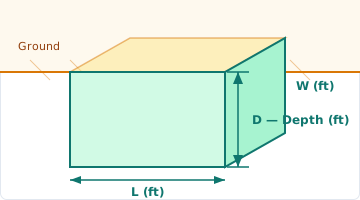
A footing is a continuous or pad foundation that distributes structural load to the soil. The concrete volume calculation is the same rectangular formula as a slab: length × width × depth. The difference is context. Footings must sit below the frost line to prevent heaving.
Frost line depths by region
The frost line is the depth at which groundwater freezes. Footings above this depth crack and shift as the ground heaves in winter. Standard depths vary significantly:
- Deep South (Florida, Gulf Coast): 12 inches or less
- Mid-Atlantic and Southeast: 12 to 24 inches
- Midwest and Northeast: 36 to 48 inches
- Northern states and mountain regions: 48 to 60 inches
- Alaska: can exceed 100 inches
Check your local building code or the ICC frost line map for the exact requirement in your area. The footing must extend below this depth, not just to it.
Continuous footing vs pad footing
A continuous footing runs around the perimeter of a structure. A pad footing (also called an isolated footing or spread footing) sits under a single column or post. For a continuous footing around a 20×20 foot structure with a 16-inch-wide, 12-inch-deep footing: perimeter = 80 ft, width = 16 in = 1.33 ft, depth = 12 in = 1 ft. V = 80 × 1.33 × 1 = 106.67 cu ft = 3.95 cubic yards. Add 10% wastage: order 4.35 yards, rounded to 4.5.
Concrete Driveway Calculator
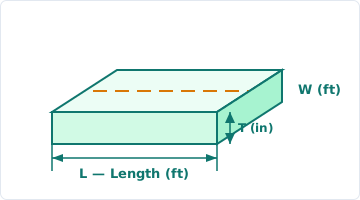
A concrete driveway is essentially a thick slab, so the formula is identical. The difference is the required thickness, which is greater than a standard patio because of vehicle loads.
Driveway thickness guide
- 4 inches: minimum for a residential driveway with passenger cars only
- 5 inches: standard recommendation for most residential driveways
- 6 inches: RVs, pickup trucks towing trailers, commercial delivery vehicles
- 8 inches or more: semi-truck access, heavy equipment staging areas
Two-car driveway concrete calculation
A standard two-car driveway measures 24 feet wide and 24 to 30 feet long. At 5 inches thick: V = 24 × 24 × (5/12) = 24 × 24 × 0.417 = 240 cu ft = 8.89 cubic yards. With 10% wastage: 9.78 cubic yards, so order 10 yards. At $150/yard, materials cost $1,500 before labor and any base preparation.
Concrete driveway reinforcement
Driveways need reinforcement more than patios because vehicle loads create tensile stress below the slab surface. Use #3 rebar on 18-inch centers (both directions) or 6"×6" W2.9/W2.9 welded wire fabric. Control joints cut one-quarter of the slab depth every 8 to 10 feet prevent random cracking without affecting the concrete volume needed.
Concrete Column, Sonotube, and Pier Volume Calculator
Cylindrical concrete forms (called Sonotubes, a brand name, or simply tube forms) are used for deck footings, structural columns, concrete piers, fence posts, and sign bases. The concrete column volume calculator uses the standard cylinder equation, as does any concrete pier volume or concrete tube volume calculation.
The radius is half the diameter. For a 10-inch Sonotube: radius = 5 inches = 0.417 feet. For more on how cylinder volume is derived and used in other contexts, see the Cylinder Volume Calculator.
Standard Sonotube sizes for deck footings
- 8-inch diameter: light deck posts, small structures
- 10-inch diameter: standard residential deck footing
- 12-inch diameter: heavier loads, taller decks, wider spans
- 16 to 24 inch: commercial columns, large structural applications
Concrete per deck post
A 10-inch Sonotube at 42 inches deep (a common frost-line depth in the Midwest): radius = 10/2 = 5 inches = 0.417 ft. V = 3.14159 × 0.417² × 3.5 = 3.14159 × 0.174 × 3.5 = 1.91 cu ft. That is about 5 bags of 60 lb concrete per post. A 12×12 foot deck typically needs 6 to 9 posts depending on beam span, so 30 to 45 bags total just for the footings.
Concrete Weight by Volume
Normal weight concrete (standard mix) weighs approximately 150 pounds per cubic foot, or 4,050 pounds (2.03 tons) per cubic yard. To calculate concrete weight by volume, multiply the volume in cubic feet by 150. Lightweight concrete mixes weigh 80 to 115 lb per cubic foot. High-density concrete used for radiation shielding can exceed 200 lb per cubic foot.
This matters when calculating structural loads. A 4-inch slab over a 20×20 foot area: 400 sq ft × 0.333 ft = 133.3 cu ft × 150 lb = 20,000 pounds (10 tons). Any structure supporting that slab needs to account for that dead load in the design.
For rectangular solids in general, the Tank Volume Calculator covers the same length × width × height formula with unit conversions to liters and gallons, useful when a concrete structure will also hold liquid (cisterns, septic tanks).
Quikrete vs Sakrete: Bag Size Guide
Quikrete and Sakrete are the two most common bagged concrete brands in North America. Both are pre-blended mixes of cement, sand, and aggregate. Both achieve 4,000 PSI compressive strength at 28 days on a standard mix. The choice usually comes down to store availability: Quikrete is the dominant brand at Home Depot, Sakrete at Lowe's.
Bag yields (both brands)
- 40 lb bag: approximately 0.30 cubic feet
- 60 lb bag: approximately 0.45 cubic feet
- 80 lb bag: approximately 0.60 cubic feet
Specialty mixes to know
Quikrete Fast-Setting Concrete: poured dry into the hole, then water added on top. No mixing required. Sets in 20 to 40 minutes. Designed for fence posts and mailbox posts, not for flatwork or structural slabs.
Quikrete 5000: achieves 5,000 PSI at 28 days. Useful for thin slabs, driveways, and high-strength applications where standard 4,000 PSI is marginal.
Sakrete High-Strength Concrete: similar 5,000 PSI target. Otherwise interchangeable with Quikrete 5000 for most applications.
Water ratio: both brands use approximately 3 quarts of water per 80 lb bag for a standard mix. Too much water reduces strength and increases shrinkage cracking. Mix only until the color is uniform and the batch is workable: do not keep adding water to make mixing easier.
Worked Examples
Example 1: 10×10 Foot Patio Slab at 4 Inches
A homeowner wants to pour a 10-foot by 10-foot patio at the standard 4-inch depth. How much concrete is needed?
Thickness in feet: 4 ÷ 12 = 0.333 ft. Volume: 10 × 10 × 0.333 = 33.33 cu ft = 33.33 ÷ 27 = 1.23 cu yd. With 10% wastage: 1.35 cu yd. Bags of 60 lb needed: ceil(33.33 × 1.10 ÷ 0.45) = ceil(81.5) = 82 bags. At $7 each: $574 in materials.
Example 2: Continuous Foundation Footing (40-Foot Perimeter)
A small shed needs a continuous perimeter footing: 10 feet × 10 feet (perimeter = 40 ft), footing width 16 inches, depth 12 inches.
Width: 16 ÷ 12 = 1.333 ft. Depth: 12 ÷ 12 = 1 ft. Volume: 40 × 1.333 × 1 = 53.33 cu ft = 1.98 cu yd. With 10% wastage: 2.17 cu yd. Order 2.5 yards (nearest half-yard). 60 lb bags if doing it by hand: ceil(58.67 ÷ 0.45) = 131 bags: a clear case for ready-mix.
Example 3: Deck Post Footing in a 10-Inch Sonotube (42 Inches Deep)
A deck builder needs to calculate concrete for one footing: 10-inch diameter Sonotube at 42 inches deep.
Radius: 10 ÷ 2 = 5 inches = 5 ÷ 12 = 0.417 ft. Depth: 42 ÷ 12 = 3.5 ft. Volume: 3.14159 × 0.417² × 3.5 = 3.14159 × 0.1736 × 3.5 = 1.91 cu ft. 60 lb bags: ceil(1.91 ÷ 0.45) = ceil(4.24) = 5 bags per post. For 8 posts: 40 bags total.
Example 4: Two-Car Driveway (24×24 Feet, 5 Inches Thick)
A standard two-car concrete driveway at 5-inch thickness.
Thickness: 5 ÷ 12 = 0.417 ft. Volume: 24 × 24 × 0.417 = 240 cu ft = 8.89 cu yd. With 10% wastage: 9.78 cu yd. Order 10 cubic yards of ready-mix. At $145/yard: $1,450 in concrete materials alone. 80 lb bags as an alternative: ceil(264 ÷ 0.60) = 440 bags. Not practical; ready-mix is the right call here.
Example 5: 10 Fence Post Holes (6-Inch Diameter, 24 Inches Deep)
A fence installer needs concrete for 10 post holes: 6-inch diameter, 24-inch depth.
Radius: 6 ÷ 2 = 3 inches = 0.25 ft. Depth: 24 ÷ 12 = 2 ft. Volume per hole: 3.14159 × 0.25² × 2 = 3.14159 × 0.0625 × 2 = 0.393 cu ft. For 10 holes: 3.93 cu ft. With 10% wastage: 4.32 cu ft. 60 lb bags: ceil(4.32 ÷ 0.45) = 10 bags total. Or use Quikrete Fast-Setting (50 lb), which needs about 1 bag per post hole at this size.
Frequently Asked Questions
How do I calculate how much concrete I need?
Multiply length × width × thickness (all in feet) to get cubic feet. Divide by 27 for cubic yards. Add 10% for wastage. For cylindrical shapes like columns or post holes, use π × radius² × depth, where radius is the diameter divided by 2, and convert inches to feet first by dividing by 12.
How many cubic yards of concrete do I need for a 10×10 slab?
At 4 inches thick: 10 × 10 × (4/12) = 33.33 cu ft ÷ 27 = 1.23 cubic yards before wastage. With the standard 10% buffer, order 1.36 cubic yards. Most suppliers round to the nearest quarter or half yard, so order 1.5 cubic yards to be safe.
How many bags of concrete per cubic yard?
One cubic yard (27 cubic feet) requires approximately 90 bags of 40 lb, 60 bags of 60 lb, or 45 bags of 80 lb concrete. Add 10% to those figures for a real job with normal wastage: 99 bags (40 lb), 66 bags (60 lb), or 50 bags (80 lb).
How many bags of Quikrete for a 10×10 slab?
At 4 inches thick you need about 33.33 cubic feet of concrete. With 10% wastage: 36.67 cu ft. Quikrete 60 lb bags yield 0.45 cu ft each: ceil(36.67 ÷ 0.45) = 82 bags of 60 lb, or 62 bags of 80 lb. These quantities apply equally to Sakrete or any other standard bag mix.
How deep does a concrete footing need to be?
At minimum, below the frost line for your area. In southern states that may be 12 inches; in the upper Midwest and Northeast, 36 to 48 inches is common. Check your local building code, which specifies the minimum footing depth for your region and soil type. Most codes also require footings to rest on undisturbed or compacted soil, not fill.
How do I calculate concrete for a driveway?
Measure the driveway length and width in feet. Decide on thickness (4 inches minimum, 5 to 6 inches recommended). Apply the slab formula: L × W × (T/12). Divide by 27 for cubic yards. For a 24×24 foot driveway at 5 inches: 24 × 24 × 0.417 = 240 cu ft = 8.89 cu yd. Order 10 cubic yards with wastage included.
How much does a cubic yard of concrete weigh?
Standard normal-weight concrete weighs approximately 4,050 pounds (about 2 tons) per cubic yard, or 150 pounds per cubic foot. A loaded ready-mix truck carrying 8 cubic yards holds about 32,400 pounds of concrete alone, not including the truck's own weight.
What is the minimum thickness for a concrete slab?
Most building codes set 3.5 inches as the minimum for any concrete slab. For a residential floor or patio with regular foot traffic, 4 inches is the practical minimum. Driveways should be 4 to 5 inches. A slab thinner than 3.5 inches is too likely to crack under load and temperature cycling to be worth pouring.
How do I calculate concrete for a sonotube?
Use the cylinder formula: V = π × r² × h. Convert the diameter from inches to feet (divide by 12), halve it for the radius, then square the radius and multiply by π and the depth in feet. A 12-inch Sonotube at 36 inches deep: r = (12/12)/2 = 0.5 ft. V = 3.14159 × 0.25 × 3 = 2.36 cu ft, which is about 6 bags of 60 lb.
How many bags of concrete per fence post?
For a standard 4×4 fence post in a 6-inch-diameter hole at 24 to 30 inches deep: roughly 1 to 2 bags of 60 lb or 80 lb per post, depending on hole size. For larger 6×6 posts in 10-inch holes at 36 inches: 3 to 4 bags per post. Use Quikrete Fast-Setting for fence posts: pour it dry, add water, and it sets in 20 to 40 minutes without mixing.
How do I calculate the dry volume of concrete?
Multiply the wet volume (the finished concrete volume the formwork needs to hold) by 1.54. This factor accounts for the voids between aggregate particles and the compaction that happens during mixing. If you need 10 cu ft of finished concrete, your dry ingredients must total 10 × 1.54 = 15.4 cu ft of loose material before mixing. This calculation applies when ordering raw cement, sand, and gravel rather than pre-mixed bags.
How do I calculate concrete volume in m³?
Calculate the volume in cubic feet first using the standard formulas, then multiply by 0.0283168 to convert to cubic meters. Alternatively, if you already have cubic yards, multiply by 0.7646. For a 10×10 slab at 4 inches: 33.33 cu ft × 0.0283168 = 0.944 m³. The calculator on this page shows the m³ result automatically in the result grid alongside cubic feet and cubic yards.
How long does concrete take to set and cure?
Initial set (hard enough not to disturb): 24 to 48 hours for standard mix, 20 to 40 minutes for fast-setting mix. Walkable: 24 hours for foot traffic. Driveable: 7 days minimum. Full design strength: 28 days. Concrete keeps gaining strength for years, but the 28-day mark is when it reaches the rated PSI used in structural calculations. Keep it moist during the first 7 days (curing) to prevent surface cracking from drying too quickly. Once it's cured, sealing the surface helps prevent the oil, paint, and rust stains covered in how to remove stains from concrete.
References
- Portland Cement Association: Concrete Mix Design: Technical guidance on concrete mix proportioning, water-cement ratios, and strength design from the leading industry body.
- QUIKRETE Technical Data Sheets: Official yield, coverage, and mix specifications for Quikrete products including standard, fast-setting, and 5000 PSI mixes.
- International Residential Code (IRC) 2021: Foundation and footing requirements including minimum dimensions, frost depth references, and bearing capacity provisions for residential construction.